


Many who venture west from Minsk towards Lida just stick to the main M6 highway. So it’s easy to miss Iwye, a small community which lies just a couple of kilometres north of the main road. Ask anyone from Belarus what they know about Iwye (Іўе in Belarusian and sometimes transliterated as Ivye or Iwje) and, if they have heard of it at all, they will almost certainly mention tomatoes. The Iwye tomato crop is said to be the finest in Belarus.
A monument erected in 2012 in the centre of town suggests that Iwye may have more to offer than tasty tomatoes. The monument celebrates religious harmony in the Iwye region, acknowledging the contributions made by Jews, Muslims, Orthodox Christians and Roman Catholics to the development of Iwye. For the Jewish community, it must be said, engagement in Iwye life ended abruptly. In the 1930s, the Jewish faithful were the most numerous group in Iwye. All but a very few perished in the Holocaust, the majority of them on a single day in May 1942 when people in the Iwye ghetto were murdered by the Nazis.
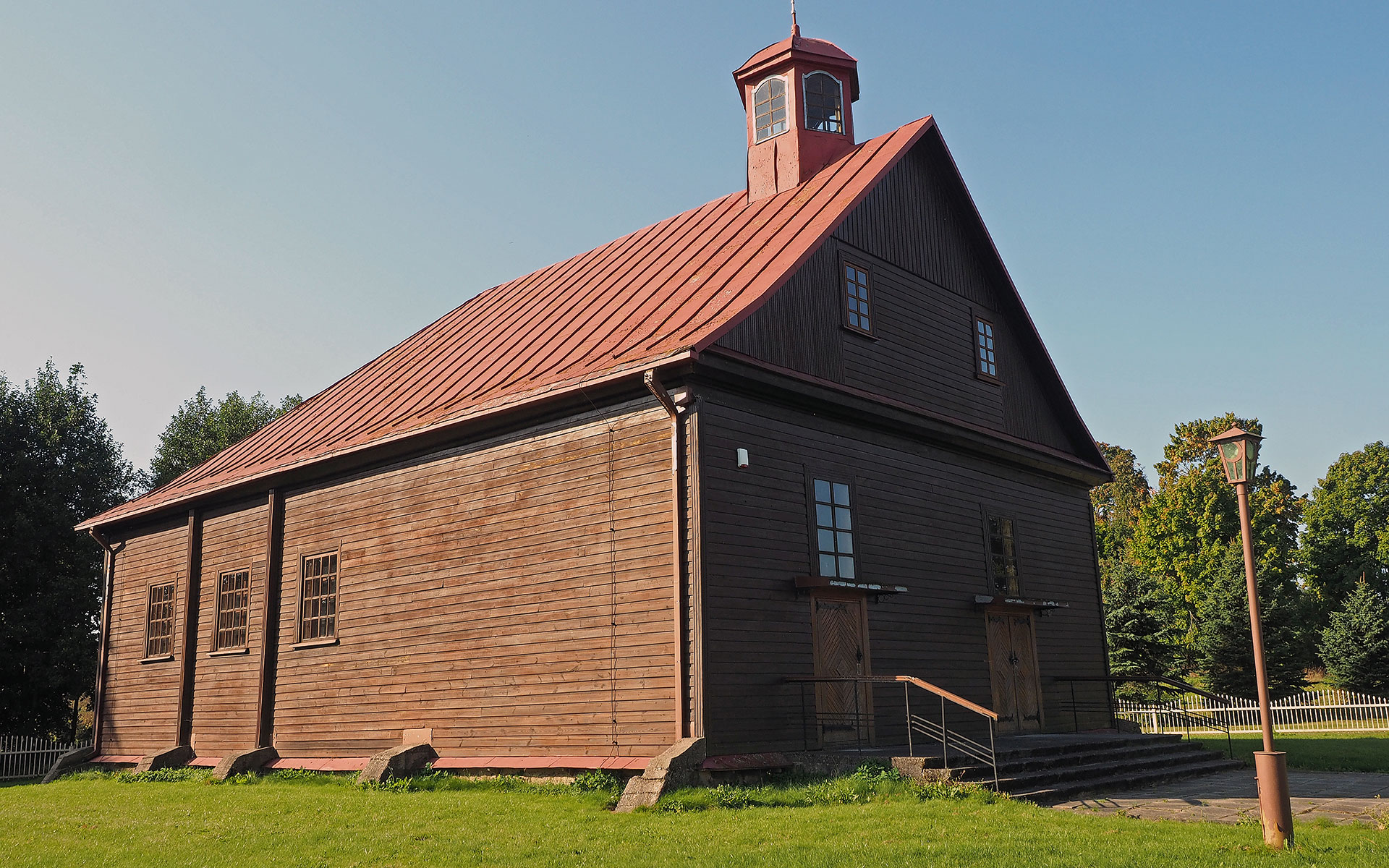
To some, the mention of Muslims in the Iwye monument may come as a surprise. Yet on the south side of town on a road called Sovietskaya, a neat wooden mosque is a quiet reminder of Islamic devotion in western Belarus.
Enclaves of Islam
At a time in Europe when antipathy towards Muslims features strongly in nationalist discourse in many countries, it is easy to forget that Muslims have been part of European life and culture for hundreds of years. But here in north-east Europe, there is an indigenous Muslim community whose members are quick to assert that they are just as Polish, Lithuanian or Belarusian as their Christian neighbours. These Muslim families are generally very rooted in rural communities and small towns; they often proudly trace local connections that extend back over centuries.
Indeed, affinity with place — and particularly the specific places where former generations of their families have lived, worked and prayed — is a defining characteristic of Islam in the eastern Baltic region. This faith community has long been a key element of the ethno-religious mosaic in a tightly defined homeland that today extends over a small part of the territory of three different countries.
Other than in matters of faith, these Baltic Muslims don’t perceive themselves to be so very different from their compatriots. They speak the same languages as their neighbours; by-and-large they eat the same food (though generally avoiding pork); their children attend the same schools; and they often have just as wide a range of views on political matters as one might find in any community.
We know of about a dozen mosques in small towns and villages in western Belarus and neighbouring parts of Lithuania and eastern Poland. Some are still well used. Others are in a state of decay. Many are old wooden buildings, but some — like the mosque in Navahrudak (Навагрудак), a town about 50 kilometres south of Iwye best known as the birthplace of the poet Adam Mickiewicz — have been rebuilt in the post-Soviet period. The celebrated wooden synagogues of precisely the same cross-border region were destroyed in the Holocaust.
Before the Holocaust, there was a symbiotic relationship between the Jews and Muslims of this region. The American researcher Holly Huffnagle has observed that the two communities “traded together on the market square, Muslims bought their fresh meat from the local Jewish shochet, Jews received fresh vegetables from their Muslim neighbours, and they even celebrated certain religious holidays together.” Huffnagle records examples of religious syncretism, with a blurring of beliefs and rituals between the Muslim and Jewish communities, noting that they also shared places of pilgrimage, citing the case of a cemetery near Navahrudak where the grave of a wise and holy man attracted both Jewish and Muslim pilgrims. These days there’s no sign of that grave, but a very small emerald-green wooden mosque with a blue minaret adds colour to the scene.
Early settlers
The traditional Muslim communities of this region of north-east Europe trace their origins back to the 14th century when the Grand Duchy of Lithuania was in the ascendant. In its heyday, Lithuanian power and influence extended from the Baltic coast south and east through territory we now know as eastern Ukraine, where on the Pontic Steppes and also in Crimea there was a substantial Tatar population. Small numbers of Tatars had settled in the Lithuanian lands in the early 14th century, but under Vytautas the Great, who became Grand Duke of Lithuania in 1392, a formal migration policy encouraged many Tatars from all strata of society to settle in the sparsely populated region south of Vilnius.
Over the centuries, the Muslim minority of this region has largely adapted to the cultural and social norms of the wider society. Traditional forms of dress have largely disappeared, yet some still adhere to the faith of their ancestors. This scattered Islamic community is Sunni, although some observers note strands of Sufi thought among some of the faithful.
A mosques at Raižiai in Lithuania, a rural community where Lipka Tatars settled in the 14th century (photo © hidden europe).
As an isolated outpost of Islamic practice in Europe, the community has historically relied considerably upon links with the Tatars in Kazan, the Mishar Tatars of the Volga region and kindred spirits in the Crimea, Turkey and the Dobruja region of south-east Romania. The latter is an area where in the mid-19th century about a quarter of the population self-identified as Muslim; today it has dwindled to a very small number, but there’s an interesting parallel between the Baltic and Dobruja Muslims as minority faith communities in regions of Europe where there is an overwhelming Christian majority.
That contact with other Muslim groups was often entirely interrupted, sometimes for decades, by politics or war — it is thus no surprise that the Islamic communities of western Belarus, eastern Poland and southern Lithuania have adapted their faith and religious practices to the cultural context of their homeland.
Even the earliest Tatar migrants to the region were quick to learn the local languages. But linguistic assimilation did not lead to the old ways being entirely discarded. The attention to the written word, notably the Holy Qur’an, meant that while the Baltic Tatars quickly acquired Belarusian or Polish they still read and understood Arabic.
As a community with a reasonable level of literacy, there was a demand for books on both secular and religious topics. Although Arabic, Belarusian and Polish were used in conversation side by side, when it came to writing, the only language was Arabic. So some early written books in the Belarusian language relied upon Arabic script, albeit with an extended alphabet to accommodate Slavic phonemes which found no parallel in the Arabic language. A rich network of Muslim-managed printing presses — there was one in Iwye — produced texts in Belarusian (and to a lesser extent also in Polish) which were rendered in the Arabic script. These early texts are known as kitabs, derived from the Arabic word for ‘book’, and together with other early texts in Latin and Cyrillic, the kitabs form part of the historic cultural capital of Belarus. Few languages have been rendered in three entirely different scripts (though within the compass of just the last 100 years Azeris have used three different alphabets).
Polish connections
From Iwye in western Belarus, it is but a short hop over the border to Kruszyniany, a small Polish village just west of the River Świsłocz which here forms the frontier between Poland and Belarus — and thus marks the outer edge of the European Union. Most visitors arriving in Kruszyniany make for Tatarska Jurta, a guesthouse run by an amiable couple called Dżenneta and Mirosław Bogdanowicz — now getting back into business after a terrible fire two years ago. Dżenneta and Mirosław are both immensely proud of their Tatar roots, though ever aware that being Muslim challenges preconceptions about homogeneously Catholic Poland. “These days we have to explain ourselves,” says Mirosław.
The Muslim community of eastern Poland is acutely aware that in Catholic Poland many contemporary social issues are viewed through the prism of faith — and attitudes towards Islam are these days often judged in the context of debates about migration and refugees.
Kruszyniany is one of two villages in northeast Poland which have surviving mosques. The other is at Bohoniki, about thirty kilometres away to the north-west of Kruszyniany. Each village has its own imān — quite a blessing in a country which has less than a dozen aʼimmah in all. The mosques in the two villages are of entirely different designs, but each community shares a common history with Islamic enclaves in nearby parts of Belarus and Lithuania. Indeed Bronisław Talkowski, who looks after the day-today running of the mosque in Kruszyniany, traces his family history right back to the original settlers brought to the region by Vytautas the Great in the closing years of the 14th century.
The inhabitants of these rural Polish outposts of Islam are deeply aware of the multi-faith identity of this part of Poland. In Kruszyniany, there is a Polish Orthodox church, part of an autocephalous community of faith within the Eastern Orthodox Communion. The erstwhile Jewish population of the region is long gone, but the Kruszyniany imān Janusz Aleksandrowicz is fond of telling the story about how this area was jokingly called “the land of three Sabbaths” — referring to Muslims, Jews and Christians celebrating the Sabbath on Friday, Saturday and Sunday respectively.
The Muslim community of eastern Poland is acutely aware that in Catholic Poland many contemporary social issues are viewed through the prism of faith — and attitudes towards Islam are these days often judged in the context of debates about migration and refugees. Kruszyniany and Bohoniki have been part of the conversation, and to some extent the two communities have been instrumentalised as the poster-kids of Polish tolerance and diversity. This rare status has brought a steady stream of visitors, including many foreign dignitaries — among them Prince Charles — to the Muslim villages. Although this has boosted the rural economy in a marginal region, it is not a situation with which many residents feel entirely comfortable.
The small homeland
A notion which binds together the indigenous Muslim outposts in Belarus, Lithuania and Poland is that of ‘the small homeland’ — mała ojczyzna in Polish. In the subjective consciousness of these communities, there is a space — its borders never really defined — where Islam has historically co-existed with the two other great Abrahamic religions: Judaism and Christianity.
Within that small homeland, a mere fragment of Europe, men and women who could recite the Qur’an diligently tilled the land and made their mark as market gardeners, as well as in other areas of agriculture. Some were learned scholars, others went to war in the service of monarchs or dictators.
This small Tatar homeland is an area now divided by frontiers, but there is a similarity to the landscape throughout the region. It is that shared landscape and a legacy of shared memories which fuel the identity of the people who are often collectively known as the Lipcani or the Lipka Tatars — the name Lipka derives from an old Tatar word for Lithuania.
Every homeland needs a name and for the Lipka Tatars that name was Lehistan, a mythical region of the mind, but one that could if pushed be vaguely mapped as territory extending east from Vilnius towards Minsk and south towards Białystok (these days an important regional centre in eastern Poland, located close to the border with Belarus).
In Raižiai, a small Lithuanian village on fertile land east of the River Nemunas, many are working to gather the tomato crop. No one has heard of Lehistan, but all are aware that it is the village mosque which attracts those few outsiders who come to Raižiai. The mosque is simple but elegant with its twin doors — one for male worshippers, and the other for the women who come here to pray. As with the Lipka Tatar communities in Belarus and Poland, the people of Raižiai are very conscious of their heritage, although these days very few still adhere to the Islamic faith. But history is important in the small homeland, and in 2010 a monument to Vytautas the Great was unveiled in the village. It is inscribed with the number 1397, recalling the year when a great influx of Tatar migrants arrived in Lithuania.
“We measure time in centuries here,” says a woman enjoying the early September sunshine by the memorial. The sundial down in the grounds of the mosque tells another story as the passage of the sun through the heavens casts a slow-moving shadow while the tomatoes are being picked.
“You like tomatoes?” asks the woman.
“Of course,” we reply, and ask how those from Raižiai stack up against the crop from Iwye across the border in Belarus so famous for its tomatoes.
“A match for each other,” says the woman. “And that’s no surprise, as they are all Tatar tomatoes. The best there are.”


